Predictive Resistance Modeling
AI analyzes behavioral signals across departments to flag resistance hotspots before they derail your initiative.
AI in Change Management
Organizations don't fail at change because of bad strategy. They fail because people don't adopt it. I've watched smart teams spend months on a perfect plan, only to discover the resistance they needed to manage was invisible until it was too late.
AI changes that. It turns qualitative resistance into quantifiable signals your team can actually act on, before the window closes.
"People will use AI based on what their boss says, does, and reinforces. Without those actions, most people simply won't change."
Ann Marvin
The Case for AI in Change
I've spent 30+ years watching smart organizations launch strong change initiatives that still stumble. The gap isn't vision; it's visibility. Leaders know something is wrong when adoption stalls, but by then it's usually too late to course-correct without a lot of pain.
AI bridges that gap by turning qualitative resistance into quantifiable signals your team can act on. Here's how I'm applying it across the AIM methodology today.
The numbers below aren't aspirational benchmarks. They're what I see in practice when organizations build the right sensing infrastructure before they launch.
AI analyzes behavioral signals across departments to flag resistance hotspots before they derail your initiative.
Real-time dashboards show exactly who is informed, willing, able, and confident, mapped against your rollout timeline.
Move beyond survey snapshots. AI surfaces leading indicators of adoption so you can intervene early, not after the fact.
"The most important shift isn't in the technology. It's in what leaders choose to measure. Once you can see resistance building in real time, the whole conversation about change management changes."
Three Core Pillars
These three capabilities represent the highest-impact applications of AI in change management today. They map directly to where I see organizations struggling most, and where even a small improvement in signal clarity changes everything.
Know before you go
Before a single training session runs or a communication goes out, AI can assess your organization's change climate. I use AI-powered diagnostic tools to aggregate survey data, meeting transcripts, and system usage patterns into a clear picture of readiness, by team, by role, and by location.
"The biggest change risk isn't the people who say no. It's the ones who say yes in the meeting and do nothing after it."
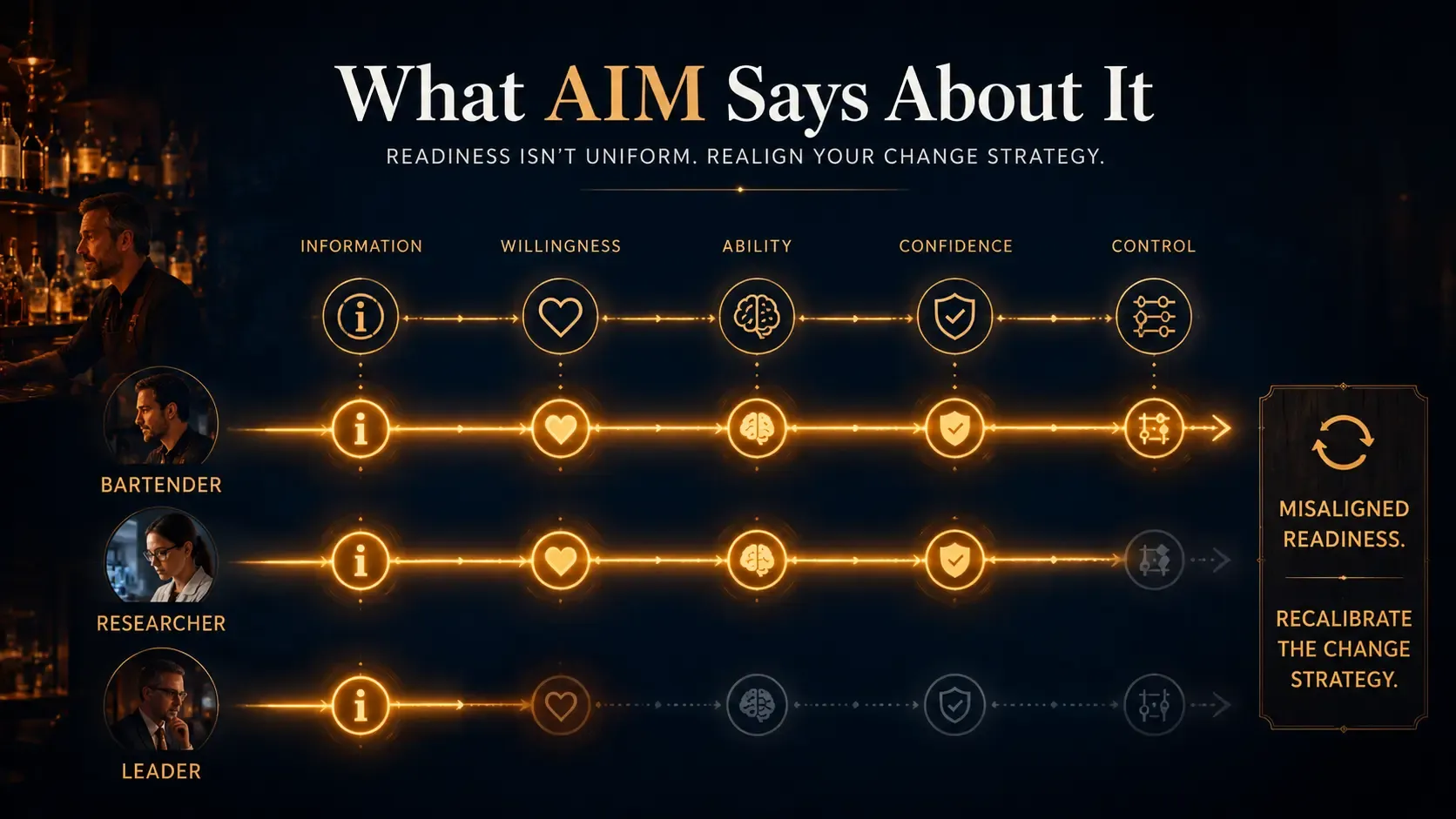
See resistance before it becomes a roadblock
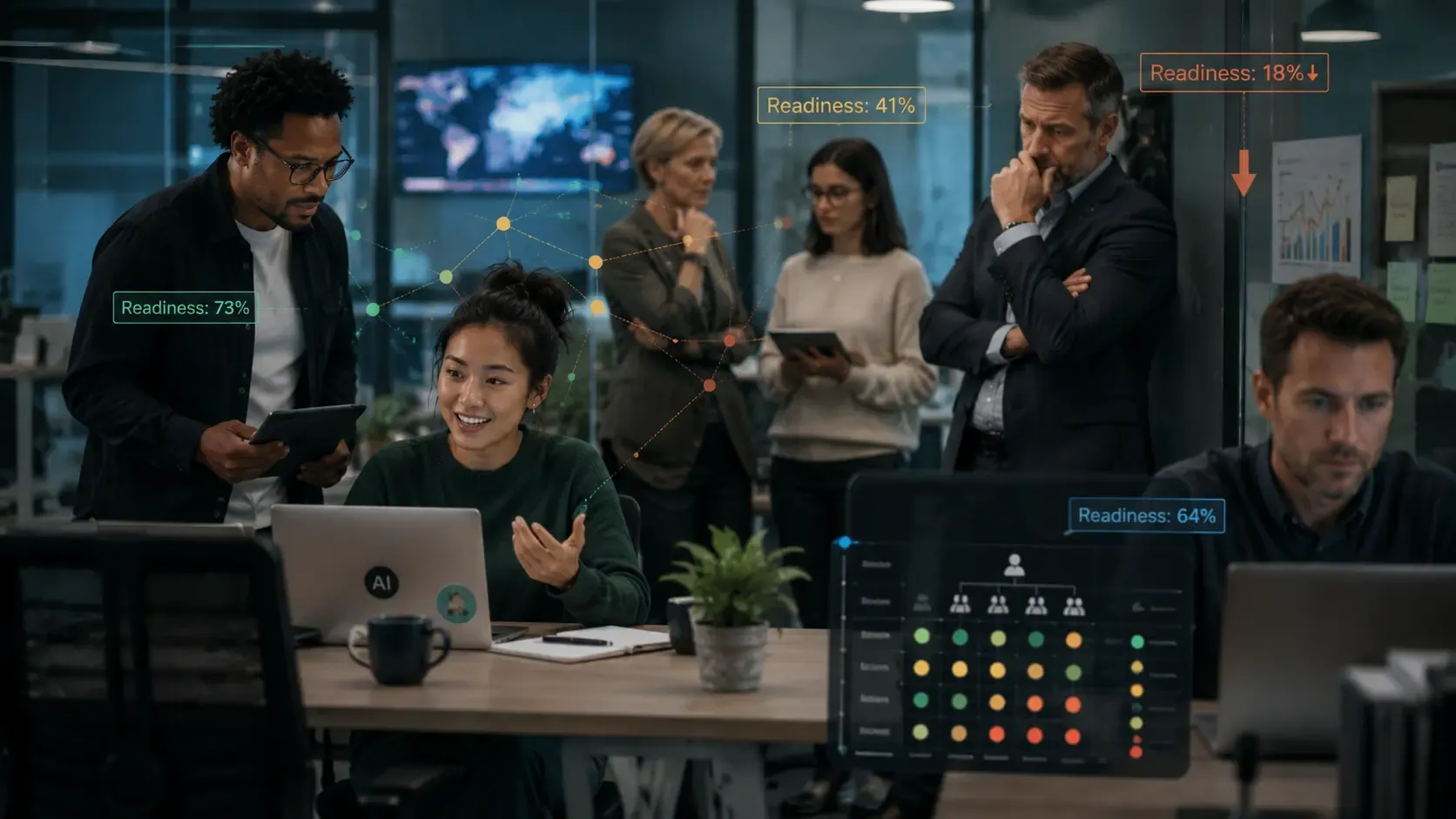
Most change teams discover resistance after it's already stalled adoption. Predictive modeling flips that script. By training models on historical change data and real-time behavioral signals, we can identify who is likely to resist, why, and when, giving leaders a window to intervene proactively.
"When you can put a probability score on resistance, it stops being a political conversation and becomes an operational one."

Move from installed to adopted, faster
Adoption isn't a launch event. It's a sustained behavior change across hundreds or thousands of individuals. AI makes it possible to track adoption velocity in near real time, so you know which teams are thriving, which are struggling, and exactly what intervention will help most.
"Counting logins is not the same as measuring adoption. One tells you who showed up. The other tells you who changed."
How It Works
The Accelerating Implementation Methodology has guided my work for decades. AI doesn't replace it; it supercharges it.
Here's the honest version of how the two work together. Not a marketing deck, just an actual description of what happens at each phase, what AI contributes, and what gets handed off to your team.
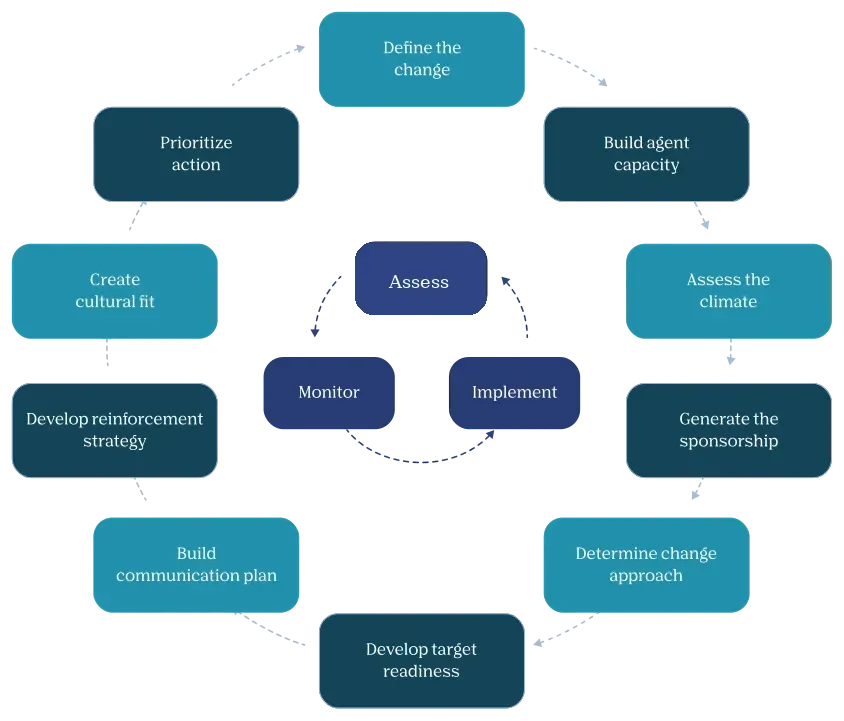
We start by defining what success looks like, not just in system terms, but in behavioral terms. What does 'adopted' actually mean for this change? Then AI tools run a baseline diagnostic across your organization to surface readiness gaps, cultural barriers, and sponsor alignment issues.
Using predictive models trained on behavioral science research and your organization's own pulse data, we build a resistance forecast. This isn't gut feel; it's a probability-weighted map of where adoption will face friction, and when. That map drives your intervention calendar.
With the roadmap in hand, we build and deploy targeted enablement. AI personalizes communication channels, learning pathways, and manager talking points based on each cohort's readiness profile. The right message reaches the right person at the right moment in their adoption journey.
We measure adoption velocity, not just logins or completion rates, but the specific behaviors that signal true embedding. Weekly AI-generated dashboards give the sponsor team a live view of progress, so resources flow toward the highest-leverage interventions in real time.
Want to see how this maps to your specific initiative? Let's build your roadmap together.
FAQ
Honest answers to the questions leaders ask most when they're considering bringing AI into their change strategy. No hype, no hedging.
Still have questions? Reach out and let's talk.
Let's Work Together
Whether you're launching an ERP, driving an AI adoption initiative, or managing a complex M&A integration, I'd love to talk through how AI-powered diagnostics can make your next change stick.
Book a ConsultationInsights & Resources
Deep dives on AIM, AI adoption, and the behavioral science behind change.
Browse InsightsBack to Home
Return to the home page to explore everything I do in change management.
Go to Home